What Are Vapor Recovery Units (VRU’s)?
A Vapor Recovery Unit (VRU) is an engineered compression package, which aims to lower emissions levels coming from the vapors of gasoline or other fuels while recovering valuable hydrocarbons to be sold or reused as fuel onsite. A package for vapor recovery is designed to capture about 95% of Btu-rich vapors, generating many benefits, guaranteeing less air pollution, and recovering gasoline vapors to be used as fuel.
Benefits of a VRU System
- Emission Reduction: Vapor recovery units play a crucial role in minimizing emissions of volatile organic compounds (VOCs) and hazardous air pollutants, contributing to a cleaner and healthier environment.
- Environmental Compliance: Utilizing VRUs ensures adherence to strict environmental regulations, helping businesses avoid costly fines and legal issues while demonstrating a commitment to sustainability.
- Cost Savings: The recovery of valuable VOCs through VRUs can lead to substantial cost savings. These captured compounds can often be reused or sold, turning waste into a valuable resource.
- Enhanced Safety: VRUs capture and contain potentially hazardous VOCs, making industrial processes safer for both workers and the surrounding community.
- Resource Optimization: By recovering and repurposing VOCs, VRUs support resource efficiency and reduce waste, aligning with sustainable practices.
- Improved Reputation: Demonstrating environmental responsibility and sustainability through VRU implementation can enhance a company's reputation and attract environmentally conscious clients and investors.
- Energy Efficiency: VRUs can be designed to recover and utilize energy from captured vapors, enhancing overall energy efficiency in industrial operations.
- Air Quality Improvement: VRUs help maintain air quality standards and reduce the release of pollutants that can harm public health.
- Carbon Footprint Reduction: By preventing VOC emissions, VRUs contribute to a reduction in greenhouse gas emissions, aiding in the fight against climate change.
- Operational Efficiency: The proper use of VRUs can streamline industrial processes, ensuring the efficient management of vapors and associated operational benefits.
Vapor Recovery System Applications
There are different applications of the Vapor Recovery systems:
- Oil tank vapors
- Marine loading terminals
- Storage terminals
- Truck loading
- Railcar loading
- Barge degassing
- Vapor particulate filter
Garo is specialized in designing and engineering custom made Tank Vapor Recovery Systems for the Oil & Gas operations, using liquid ring compressors as the means of compression.
How Vapor Recovery Units for Tank Farms or Upstream Process Separators Work
When crude oil is stored in storage tanks, the vapor space above the liquid will become saturated with VOCs to reach equilibrium. Changing liquid levels due to loading and unloading of the tank will cause changes in the vapor space.
As the tank is unloaded (drained) vapor must be added into the tank above the liquid to maintain a slightly positive pressure inside the tank to keep it from collapsing as the liquid is evacuated. As the tank is loaded (filled) the vapor above the liquid must be removed to keep the tank from over pressuring and potentially rupturing.
Ambient temperature changes can also change the vapor pressure inside the tank above the liquid and can lead to the venting of the VOC saturated vapor to the atmosphere or allow to air ingress into the tank, if the tank is rapidly cooled, forming a potentially explosive atmosphere inside the tank. The VOC containing vapor that is vented through boil-off (hot ambient days) or through loading operations can be recovered and compressed.
Tank Vapor Recovery Unit - Process Flow
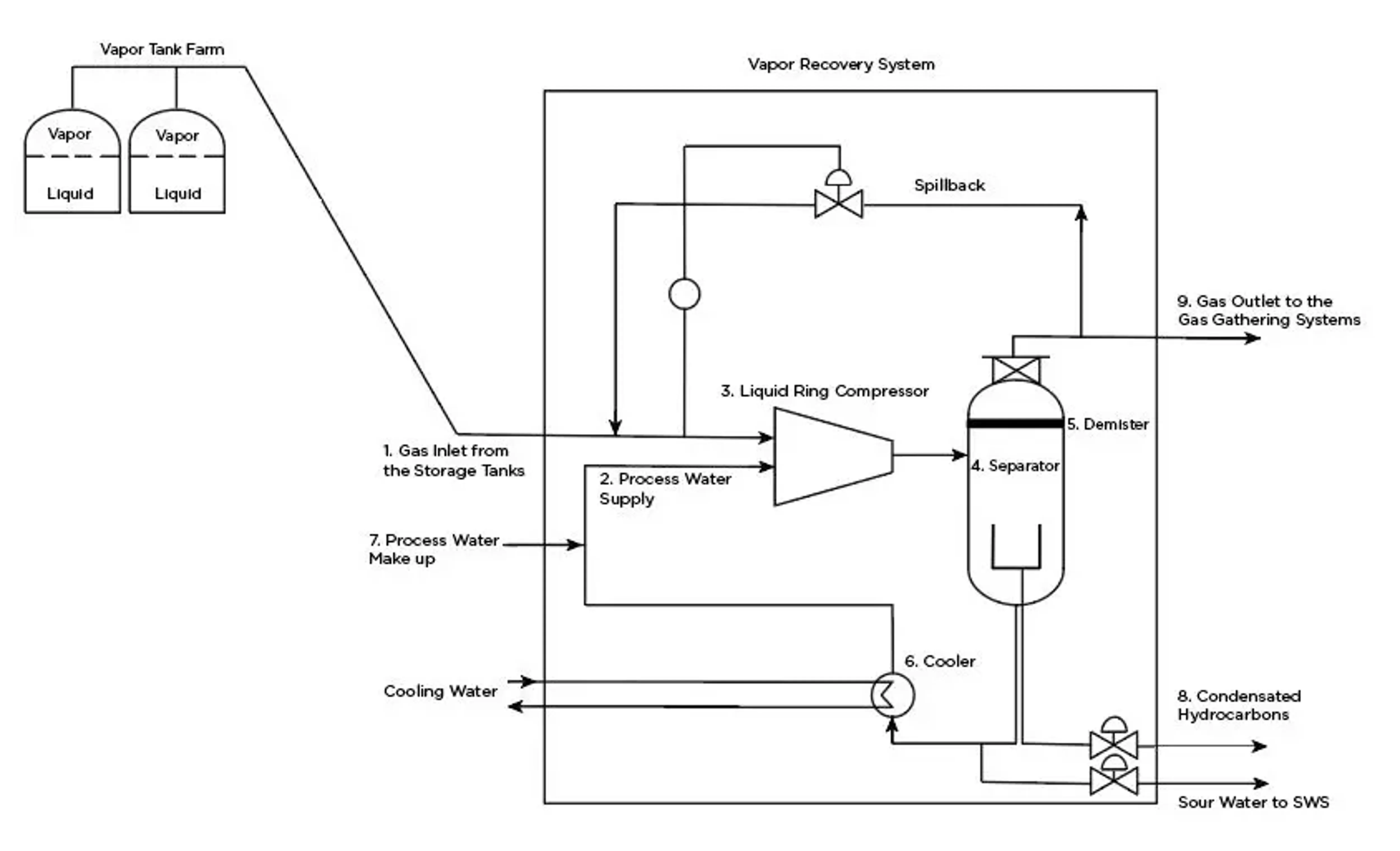
The gas (1) coming from the tank farms enters the Liquid Ring Compressor (2) along with the process water (3).
After the compression phase, the gas, water and hydrocarbon mixture enters the separator(4) where the three elements are parted: the gas passes through a demister (5)to remove water droplets and leaves the vessel from the top, while condensed hydrocarbons and water are separated from the vapor stream by gravity due to reduced gas speed.
The water is sent back to the compressor, afterbeing cooled by a cooler (6). Moreover, continuous process water make up line(7) in the compressor, suction is provided to ensure a continuous water ring inthe compressor. The condensed hydrocarbons are discarded or put back into thetanks (8). The gas exiting the separator finally heads to the Gas GatheringSystem (9).